Short Physical Performance Battery (SPPB)

The SPPB is a standardized, validated tool for assessing lower-extremity physical function in older adults. Comprising three objective subtests—balance, gait speed, and five-times sit-to-stand—it is widely used in frailty and sarcopenia research, clinical assessment, and integrated care for older people.

Components of the SPPB

Each subtest targets a distinct dimension of lower-extremity function and is scored 0–4, giving a maximum total score of 12.

Full Test Protocol →

Interpreting SPPB Scores

Each of the three subtests is scored 0–4. The total composite score (0–12) reflects overall lower-extremity function.

Total Score Category Clinical significance
0 – 6 Severe impairment High risk of mortality, falls, hospitalization, and mobility disability. Priority for intervention.
7 – 9 Moderate impairment Intermediate risk. Greatest responsiveness to exercise and rehabilitative interventions.
10 – 12 Normal to good function Lower risk. Useful baseline for longitudinal monitoring.

The subtest profile matters as much as the total score. Isolated balance impairment, slow gait, or disproportionately slow chair stand performance each point toward different clinical targets.

In-depth clinical reference on SPPB evidence and guidelines →

SPPB as a Predictor of Adverse Outcomes

Beyond scoring lower-extremity function, SPPB independently predicts mortality, fall risk, and mobility disability in community-dwelling older adults.

The SPPB captures the cumulative burden of age-related functional decline across balance, gait, and lower-limb strength — making it a comprehensive frailty biomarker. Low scores (≤6) are associated with substantially elevated 5-year mortality, hospitalization risk, and fall incidence.

A systematic review and meta-analysis (Pavasini et al., 2016; n > 30,000) confirmed that each 1-point increment in SPPB score is associated with a statistically significant reduction in all-cause mortality risk. The same gradient is observed for hospital readmission, nursing home admission, and incident mobility disability.

From a frailty perspective, SPPB reflects the physical phenotype dimension of the Fried frailty criteria — slow gait speed and weak lower-limb strength — while the balance subtest adds information on postural control and fall risk not captured by gait alone.
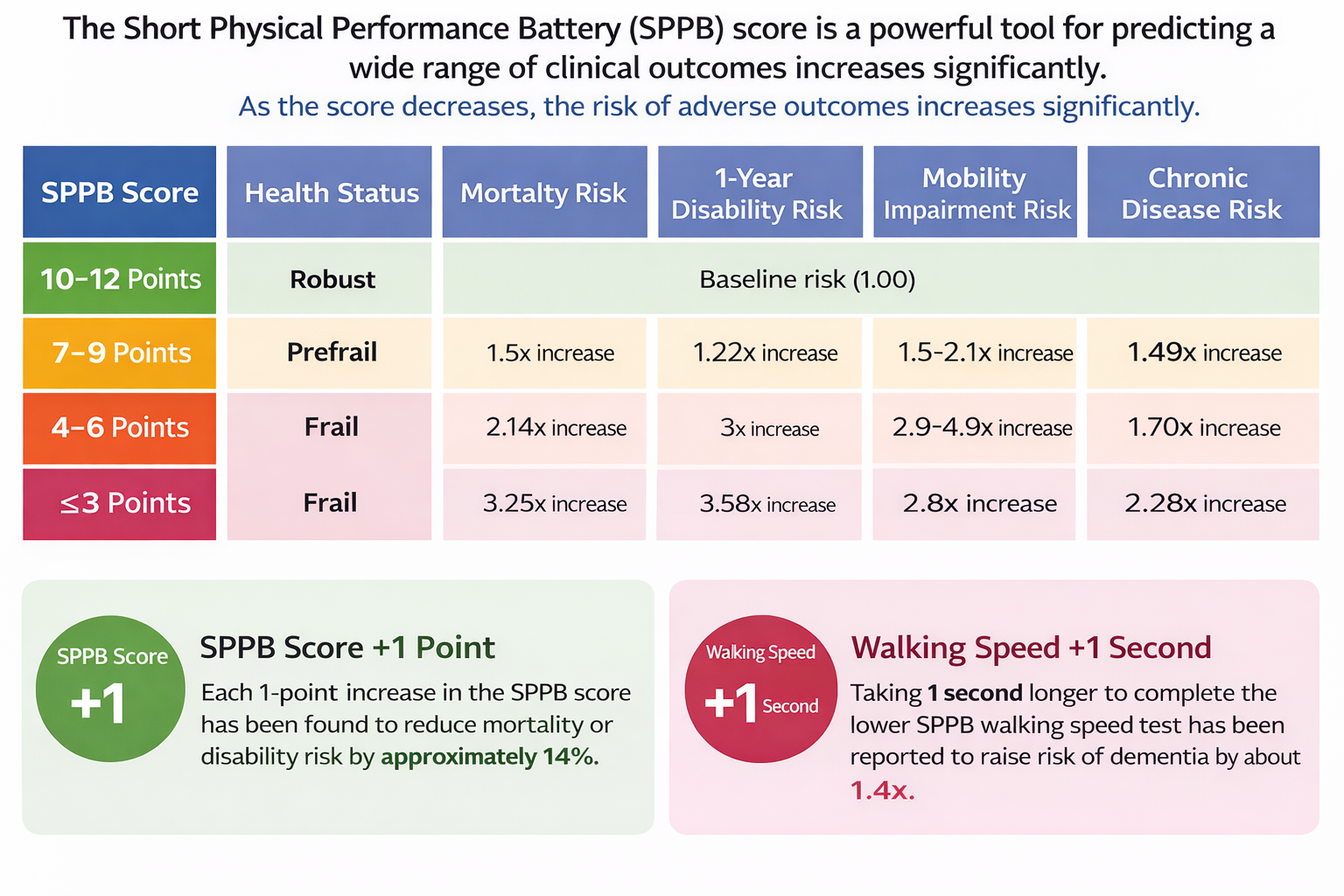
SPPB score and prognostic risk for mortality and falls in older adults

SPPB scores predict 5-year mortality, fall risk, and hospital admission. Each additional point corresponds to meaningfully reduced adverse outcome risk.

Academic References
  1. Guralnik JM, Simonsick EM, Ferrucci L, et al. A short physical performance battery assessing lower extremity function: association with self-reported disability and prediction of mortality and nursing home admission. J Gerontol. 1994;49(2):M85–M94.
  2. Guralnik JM, Ferrucci L, Pieper CF, et al. Lower extremity function and subsequent disability: consistency across studies, predictive models, and value of gait speed alone compared with the short physical performance battery. J Gerontol A Biol Sci Med Sci. 2000;55(4):M221–M231.
  3. Pavasini R, Guralnik J, Brown JC, et al. Short Physical Performance Battery and all-cause mortality: systematic review and meta-analysis. BMC Med. 2016;14:215.
  4. Perera S, Mody SH, Woodman RC, Studenski SA. Meaningful change and responsiveness in common physical performance measures in older adults. J Am Geriatr Soc. 2006;54(5):743–749.
  5. Volpato S, Cavalieri M, Sioulis F, et al. Predictive value of the Short Physical Performance Battery following hospitalization in older patients. J Gerontol A Biol Sci Med Sci. 2011;66(1):89–96.
  6. Kwon S, Perera S, Pahor M, et al. What is a meaningful change in physical performance? Findings from a clinical trial in older adults (the LIFE-P study). J Nutr Health Aging. 2009;13(6):538–544.
  7. Studenski S, Perera S, Patel K, et al. Gait speed and survival in older adults. JAMA. 2011;305(1):50–58.
  8. Buracchio TI, Dodge HH, Howieson D, Wasserman D, Kaye J. The trajectory of gait speed preceding mild cognitive impairment. Arch Neurol. 2010;67(8):980–986.
  9. Welch C, Hassan-Smith ZK, Greig CA, Lord JM, Jackson TA. Acute sarcopenia secondary to hospitalisation — an emerging condition affecting medical inpatients. Gerontology. 2018;64(2):158–166.
  10. Fried LP, Tangen CM, Walston J, et al. Frailty in older adults: evidence for a phenotype. J Gerontol A Biol Sci Med Sci. 2001;56(3):M146–M156. [Women's Health and Aging Study]

SPPB in Clinical Guidelines and Research Frameworks

SPPB is endorsed across major clinical domains by guideline bodies in Europe, North America, Asia, and globally.

Clinical Domain Guideline / Body Role of SPPB
Sarcopenia EWGSOP2 (Europe, 2018) Primary physical performance criterion for diagnosis
Sarcopenia FNIH Sarcopenia Project (USA, 2014) "Weak + slow" phenotype criterion; gait speed threshold ≤0.8 m/s
Sarcopenia AWGS 2019 (Asia) Physical performance measure for diagnosis and severity classification
Integrated Care WHO ICOPE (2019) Locomotion capacity screening for community-dwelling older people
Oncology ASCO (2018) Physical function domain within comprehensive geriatric assessment (CGA)
Oncology ESMO/SIOG (2021) Functional assessment and chemotherapy toxicity risk stratification
Cardiac Rehab JCS/JACR (Japan, 2021) Lower-extremity functional assessment in cardiac rehabilitation
Cohort Research NHANES (USA) Physical performance module for population-level functional tracking
Cohort Research KLHAS (Korea) Functional trajectory tracking in national aging cohort
Clinical Trials SPRINT (USA, 2016) Physical performance and gait speed outcome measures

SPPB in National and International Policy

Beyond research, SPPB has been integrated into health system frameworks and national care programs worldwide.

🇰🇷 Republic of Korea — National Integrated Care Program

A national Delphi consensus study recommended SPPB as the standard physical performance assessment in integrated care programs for community-dwelling older adults in Korea. SPPB is now incorporated into regional frailty prevention programs operated through public health centers, enabling standardized functional screening at scale.

🌍 WHO — ICOPE Framework

The WHO Integrated Care for Older People (ICOPE) framework explicitly endorses SPPB as the assessment tool for the locomotion domain, establishing it as a global reference standard for population-level functional screening of older adults. The framework guides health systems in over 100 countries to adopt SPPB as their functional assessment protocol.

🇪🇸 Spain / Europe — CIBERFES Consensus

The Spanish CIBERFES network (Centro de Investigación Biomédica en Red — Fragilidad y Envejecimiento Saludable) and European aging consortia have endorsed SPPB as a consensus measurement tool for clinical trials and cohort studies in aging research, underscoring its cross-national comparability and methodological robustness.

Administer SPPB with AndanteFit

AndanteFit automates all three SPPB subtests with multi-sensor technology, removing the need for manual timing and trained operators at every session. Peer-reviewed studies confirm high agreement with conventional manual SPPB (ICC 0.94–0.97).

Validation Studies About AndanteFit